This page is available in:
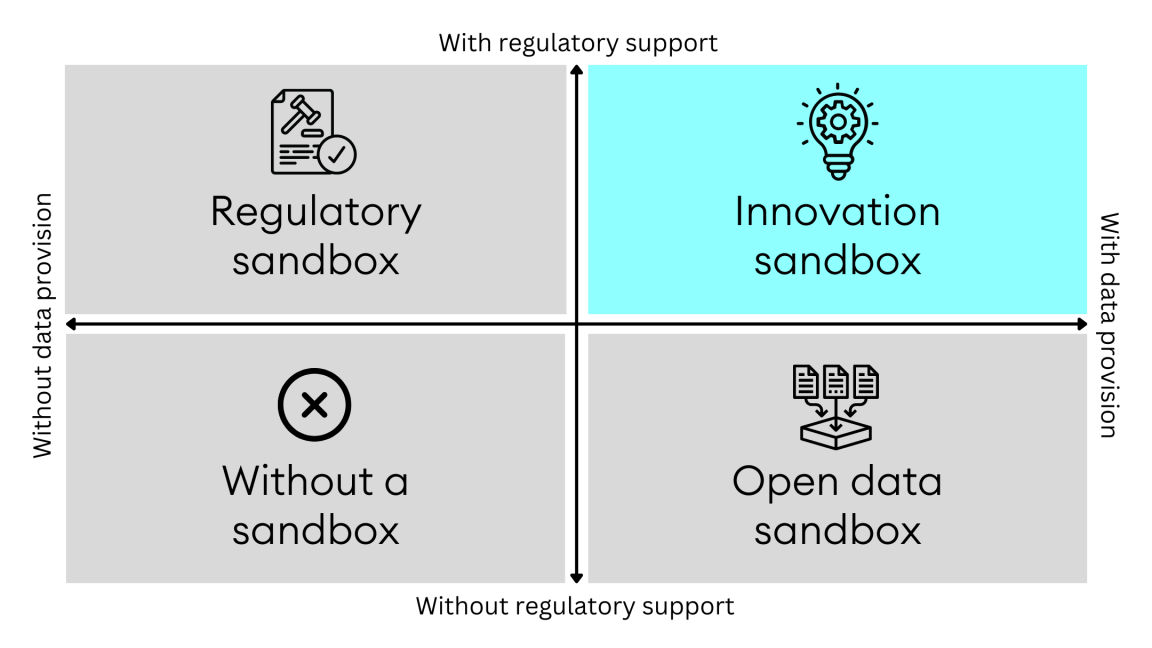
The Innovation Sandbox for Artificial Intelligence (AI) is a test environment for the implementation of AI projects. It is designed to promote responsible innovation by allowing public administration and participating organizations to collaborate closely on regulatory issues and enabling the use of new data sources.
News from the Sandbox
Sandbox: A Test Environment for AI Innovation
Due to the rapid pace of technological progress, the regulatory environment for AI technologies is often unclear for businesses, research institutions, and public administrations. As a result, uncertainties arise when implementing AI projects, which can hinder innovation. The Innovation Sandbox provides a testing
environment where stakeholders can carry out AI initiatives within a clearly
defined framework.
Start-ups, SMEs, large enterprises, and research institutes gain access to
regulatory expertise and novel data sources through the sandbox, enabling them to
foster innovation and support data-driven developments. Collaborative work within the sandbox also ensures effective knowledge transfer between
participating organisations. All insights and results are shared publicly and serve as valuable input for shaping future legal frameworks.
Unlike many international approaches, the Innovation Sandbox for AI goes one step further: submitted projects are not only reviewed but also implemented in practice.
The goal is to promote responsible innovation that takes legal and ethical
considerations into account, and to sustainably strengthen the use of AI in
public administration, business, and research.
Phase III: Current Phase
A total of 57 applications were received for the third round of the Innovation Sandbox for AI in spring 2026. The steering committee selected eight projects to take part. These projects have been underway since September 2026. The results are being published on an ongoing basis.
Use the accordion controls to toggle the visibility of each panel (below the controls).
Robots equipped with cameras, microphones and other sensors can take on new tasks in public spaces, particularly where staff resources are limited or where operations may be hazardous for people. At the same time, their use raises legal, ethical and societal questions about where such data collection is permissible and socially acceptable. This project brings together different stakeholder groups to identify suitable use cases and conditions, including data protection requirements, for the robot-based and AI-supported analysis of image, audio and sensor data. The findings will be translated into a practical guideline or requirements framework.
Balancing competing interests is a central element of spatial planning, and its importance continues to grow as planning environments become increasingly complex. While such assessments contribute to balanced decision-making, they are methodologically demanding and resource-intensive. This project examines how AI systems can support professionals in preparing interest-balancing assessments, for example by identifying gaps in reasoning and highlighting additional professional perspectives. It also explores how effectively AI systems can support reviewing authorities in assessing existing interest-balancing exercises and what an effective division of responsibilities between human experts and AI systems could look like.
Access to justice presents significant barriers for many individuals and businesses, particularly where legal expertise is lacking. AI creates new opportunities to lower these barriers. However, it is essential to determine where its use is appropriate and responsible, and where human advice or decision-making must remain indispensable. This project examines the potential uses and limitations of AI in providing low-threshold access to legal information and support. It also explores how compliance with human rights and the protection of mental health can be incorporated into the design of AI applications from the outset.
Language barriers make the work of professionals in public administration, policing, education and healthcare more difficult, particularly in direct interactions with the public. AI-supported real-time translation of spoken language could facilitate communication, but also raises legal, professional and interpersonal questions. This project examines the situations in which such systems may and should be used, the reliability requirements they need to meet, and how their use affects interactions between professionals and members of the public.
Public-sector application and service-delivery processes are often complex, resource-intensive and characterised by fragmented systems and media discontinuities. Specialised AI agents could review documents and eligibility, assess legal compliance, coordinate activities across interfaces, and generate traceable recommendations for caseworkers. Using a specific administrative process as a test case, this project examines how such partial automation can be designed and where human judgement must remain indispensable. The project also aims to contribute to the development of a reference architecture for legally compliant and auditable AI agents in public administration.
Open AI models and applications are becoming increasingly capable, but their use raises questions around security, operations and accountability. Using the open-source AI solution «Spark» as a case study, this project examines the technical, organisational and legal requirements associated with its use and the extent to which these requirements can be met. It also aims to generate insights into how employees can work effectively with AI agents in their day-to-day activities and how the activities of these agents can be appropriately supervised.
Demand for care and support outside hospitals continues to grow. At the same time, healthcare professionals face a substantial workload from activities beyond direct care, including planning, coordination and documentation. This project examines and tests in practice where AI can deliver the greatest reduction in workload and improvements in quality, and which conditions must be met to ensure its use is legally compliant, responsible and centred on human needs.
Providing patients with adequate information is a fundamental prerequisite for informed medical decision-making. However, the conversations required for this process place considerable demands on the time of medical professionals. This project examines the extent to which AI avatars can and should support the provision of information to patients. The central question is how such a process can be designed effectively and responsibly, and at which points the personal involvement of healthcare professionals must remain indispensable.
Phase II: 2024-2026
In the second project call of 2024, 24 organisations submitted their AI projects. The project team successfully implemented five projects by the end of 2025. The final report summarises the findings from this phase.
Use the accordion controls to toggle the visibility of each panel (below the controls).
Building permit procedures are complex. This project analysed the
capabilities of AI models in reviewing building application and
developed a prototype for an AI-based preliminary check of solar
installations, heat pumps and charging stations. The findings provide
local authorities and suppliers with valuable insights for digital
transformation in the construction sector.
AI To Streamline the Reporting Process for Planning Permission

Many bridges are decades old and still primarily inspected visually. This project tests AI-powered sensors that continuously monitor the
vibration behaviour of bridges. This enables early detection of
structural fatigue and allows for informed assessments of load-bearing capacity. The data-driven approach aims to extend the service life of bridges and make maintenance more efficient.
Swiss South-East Railway & irmos technologies test bridge monitoring with AI
Diagnosing eye diseases is complex and requires specialist expertise. This project develops an AI-based approach for detecting diabetic retinopathy and investigates how AI can be reliably integrated into
clinical routines. In addition to medical advancements, the project offers practical recommendations that can be transferred to other disciplines such as radiology or dermatology.
Stadtspital Triemli Pioneers the Future of Diagnostics With Oculomics & AI
For many Swiss robotics companies, access to the EU market is crucial – yet regulatory complexity is increasing. This project analyses key
legislative frameworks such as the AI Act, the Machinery Regulation, the Cyber Resilience Act, and the Data Act, and demonstrates how
companies can effectively navigate these various requirements.
In addition, the project tests AI governance software designed to help firms efficiently implement technical, legal, and organisational
standards – for example, those set out in ISO 42001.
EU Regulation of Industrial Robots for Critical Infrastructure
In healthcare, documentation requirements generate a lot of
administrative work. This project shows how speech recognition and large language models (LLMs) can reduce this workload. At the same time, it examines the legal framework – for example, with regard to data protection, professional secrecy and cloud use – and clarifies when such systems are considered medical devices. The aim is to develop concrete best practices for the safe and responsible use of AI in
medical documentation.
AI in Medical Documentation – Between Potential and Regulation
Phase I: 2022-2024
The first phase of the Innovation Sandbox for AI was successfully completed in September 2024. The insights gained from five AI projects have been published. Key findings from the development and operation of the sandbox were summarised in a final report.
Use the accordion controls to toggle the visibility of each panel (below the controls).
A growing number of autonomous systems such as self-driving tractors or lawn mowers will potentially be used in public spaces. In many cases, the general regulatory environment in areas such as
standardisation, admission to public roads or data protection are not clear to manufacturers. This project is focused on developing
comprehensive guidelines that provide manufacturers with an overview of the most relevant factors.
How Will Autonomous Systems Be Regulated in the Future?
Maintenance of infrastructure, such as bridges, roads or pylons, is
often carried out by human staff. Many of the tasks involved are
time-consuming and, in some cases, dangerous. This project is centred on creating high-resolution drone images to detect cracks and damage on airport runways.
What Role Will AI Play in Infrastructure Maintenance?
Education is increasingly supported by AI, including at elementary level. The basic legal parameters, e.g. in the domain of data protection, are to some extent unclear to providers, teachers, parents and pupils. This project focuses on clarifying the legal bases for use of image
recognition for the automated correction of handwritten schoolwork.
What Role Will AI-Based Image Recognition Play in Schools in the Future?
Many public administration offices deal with multiple languages in their daily work. The potential for machine translations is significant. As their work often involves sensitive information and use of specific technical terminology, the question arises as to whether generic and publicly
accessible translation tools may and should be used. This project
focuses oncoming up with recommendations for the use of machine translation. The case studies stem from the Commercial Register Office and the Integration Office.
What Potential Does AI Have for Translations in Administrations?
Parking management is a highly significant challenge for many cities and municipalities. Relevant data on utilization and occupancy of
parking spaces is often lacking. That hinders informed decision-making on traffic planning or the introduction of parking guidance systems.
AI-based image recognition can create the necessary data basis for this. In this project, privacy-by-design measures are being developed for the responsible use of camera systems in public spaces.
Smart Parking: Best Practices for Image Recognition
Open resources from the Sandbox projects
Some of the Sandbox projects generate digital resources (e.g. data collections, software code or technical interfaces) that can be used beyond the scope of the individual project and shared publicly.
The following resources are currently available:
- Prototype for the preliminary assessment of planning applications: An application for the automated assessment of whether selected planning applications meet the defined formal requirements.
- Image datasets for infrastructure monitoring: Data collections for testing and further developing AI applications in the field of visual inspection.
- Real-time data for smart parking solutions: Data and interfaces from the Smart Parking project (Phase 1).
The resources are made available on a public platform and are continuously updated:
In the Media
- AI, Start-Ups and Angel Investing: How Switzerland Can Unleash Its Potential, Innovation Zurich, 12th Augusut 2025
- AI Agents in Practice: How Companies Benefit From Autonomous Systems, Innovation Zurich, 5th August 2025
- When Quantum Computers Become Reality- Dr. Heike Riel in the AI Talk Podcast, Innovation Zurich, 23th July 2025
- AI and the Labor Market: How Artificial Intelligence Is Changing Jobs and Skills, Innovation Zurich, 16th July 2025
ch.zh.web.internet.core.components.feedback.pleasegivefeedback
Is this page comprehensible?
Thank you for your feedback
Contact
Office for Economy – Business and Economic Development Division
Monday to Friday
8 a.m. to 12 a.m.
1.30 p.m. to 5 p.m.
