This page is available in:
The Innovation Sandbox for Artificial Intelligence (AI) is a testing environment in which businesses, public authorities and research organisations work together to implement AI projects under real-world conditions. It promotes responsible innovation by enabling participating organisations to collaborate closely on regulatory issues and to utilise novel data sources.
Sandbox: A Test Environment for AI Innovation
Due to the rapid pace of technological progress, the regulatory environment for AI technologies is often unclear for businesses, research institutions, and public administrations. As a result, uncertainties arise when implementing AI projects, which can hinder innovation. The Innovation Sandbox provides a testing
environment where stakeholders can carry out AI initiatives within a clearly
defined framework.
Start-ups, SMEs, large enterprises, and research institutes gain access to
regulatory expertise and novel data sources through the sandbox, enabling them to foster innovation and support data-driven developments. Collaborative work within the sandbox also ensures effective knowledge transfer between
participating organisations. All insights and results are shared publicly and serve as valuable input for shaping future legal frameworks.
Added value
Advantages:
- Creating regulatory clarity
- Promoting access to data and innovation
- Ensuring the transfer of know-how
- Providing input for the future regulatory framework
Unlike many international approaches, the Innovation Sandbox for AI goes one step further: submitted projects are not only reviewed but also implemented in practice.
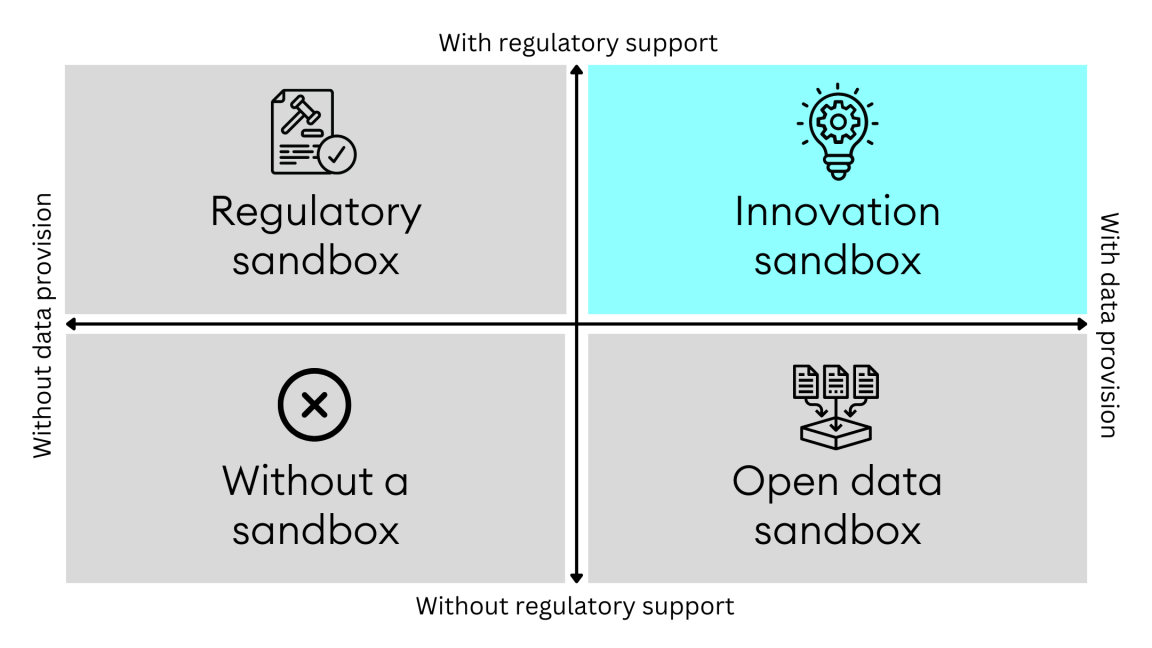
The Innovation Sandbox for AI is neither a traditional regulatory nor a technical sandbox: it operates within the existing legal framework and does not allow for any temporary relaxations or deviations from regulatory requirements. AI
systems are also not developed and tested in isolated, dedicated test
environments, but are implemented in environments selected and designed specifically for each project. This ensures practical testing under real-world
conditions whilst complying with legal and organisational requirements.
The Innovation Sandbox for AI is industry-neutral in its approach, but focuses particularly on projects in complex and trust-critical areas, as the need for
clarification and learning is particularly high there. To date, projects have been implemented in areas including healthcare, mobility, logistics, agriculture,
education and core administration.
The goal is to promote responsible innovation that takes legal and ethical
considerations into account, and to sustainably strengthen the use of AI in
public administration, business, and research.
The impact of the sandbox unfolds across three interlinked levels:
Impact within the sandbox projects (project level)
The focus is on the immediate benefits for the participating AI providers and
public partners, as specific implementation issues are addressed directly within the project context. Regulatory issues are clarified at an early stage, structured
access to relevant data sources is facilitated, and technical and organisational
challenges in pilot projects are resolved collaboratively.
Knowledge transfer within the AI ecosystem (transfer level)
The insights gained in the projects are systematically processed and made
accessible beyond the individual case to ensure their transferability and
compatibility. In this way, experiences regarding legal frameworks, data access, organisational requirements or technical solutions are made available to other
stakeholders through reports and events.
Systemic impact and public anchoring (policy level)
At this level, project findings are translated into structural developments, whether this involves the further development of regulatory requirements, the
specification of enforcement practices, or the strategic management of AI at the
administrative level. This level ensures that operational projects generate sustainable structural impact.
Selection of projects
Requirements for project applications
Contribution of in-house AI expertise
Organisations must possess their own expertise in the field of artificial
intelligence. This primarily encompasses technical know-how and the use of specific AI applications. The Sandbox team does not provide technological
solution development.
No financial compensation
Participating organisations must contribute their own human resources and waive any financial compensation. Participation in the Sandbox project provides access to legal expertise and relevant data. The Sandbox covers no costs incurred for additional third-party services (e.g. computing power, data processing,
procurement of hardware, installation of infrastructure, etc.).
Willingness to publish findings
Organisations must be willing to share the insights gained within the framework of the Sandbox project. This includes the publication of results and best
practices in the form of reports and events. This does not concern IP-related
aspects such as code or other sensitive product information.
Headquarters in Switzerland
Participating organisations must have a presence (e.g. headquarters or
subsidiary) in Switzerland and may submit a maximum of one AI project to the Sandbox.
Application process
- Submission: Use a simple online form to submit a written application.
- Validation: A 30-minute interview is held to assess your motivation and professional expertise.
- Prioritisation: The Steering Committee carries out a final evaluation and prioritisation.
Our partners
The success of the Innovation Sandbox for AI is based on the collaboration of numerous stakeholders who have enabled and further developed the project through their specialist expertise, operational support, access to real-world applications and institutional backing. Listed below are the organisations and communities that made a significant contribution during Phases 1 and 2, as well as at the start of Phase 3.
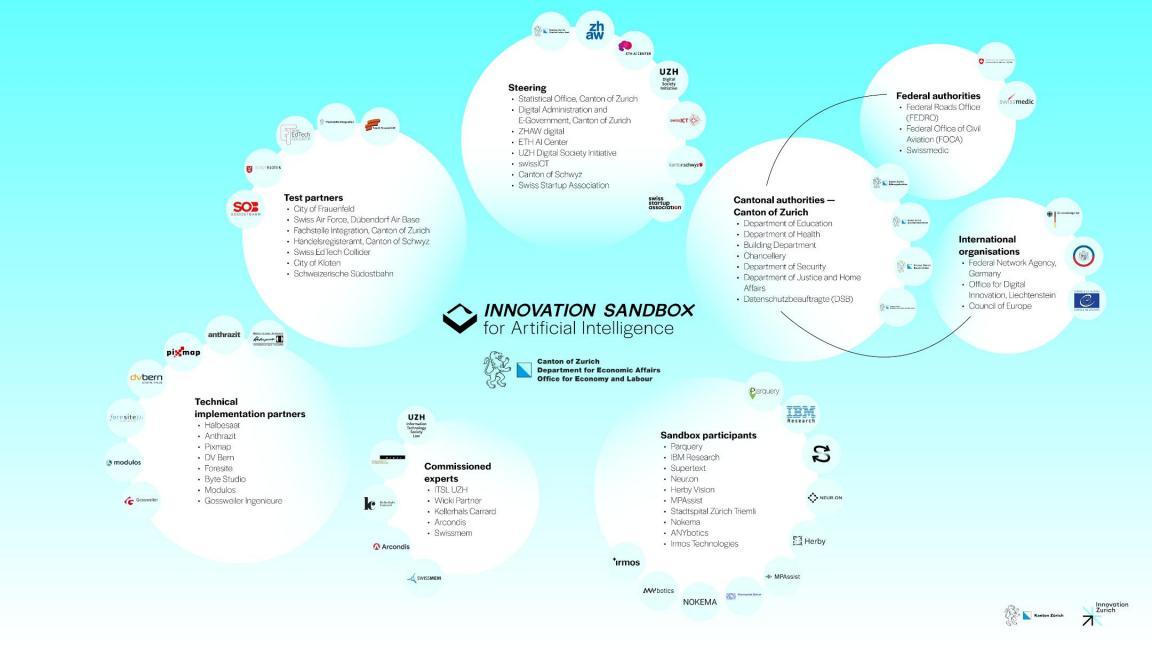
- Division of Business and Economic Development within the Office for Economy of the Canton of Zurich
- Office for Economy, Canton of Schwyz
- Office for Statistics and Data, Canton of Zurich
- Digital Administration and E-Government, Chancellery of the Canton of Zurich
- ETH AI Center
- UZH Center for Information Technology, Society, and Law (ITSL)
- UZH Digital Society Initiative (DSI)
- swissICT
- ZHAW digital
- Swiss Startup Association
- Zurich Metropolitan Area
Sandbox team
We are an interdisciplinary team. Depending on the project requirements, we work with a network of external service providers.





Awards
Digital Economy Awards 2025
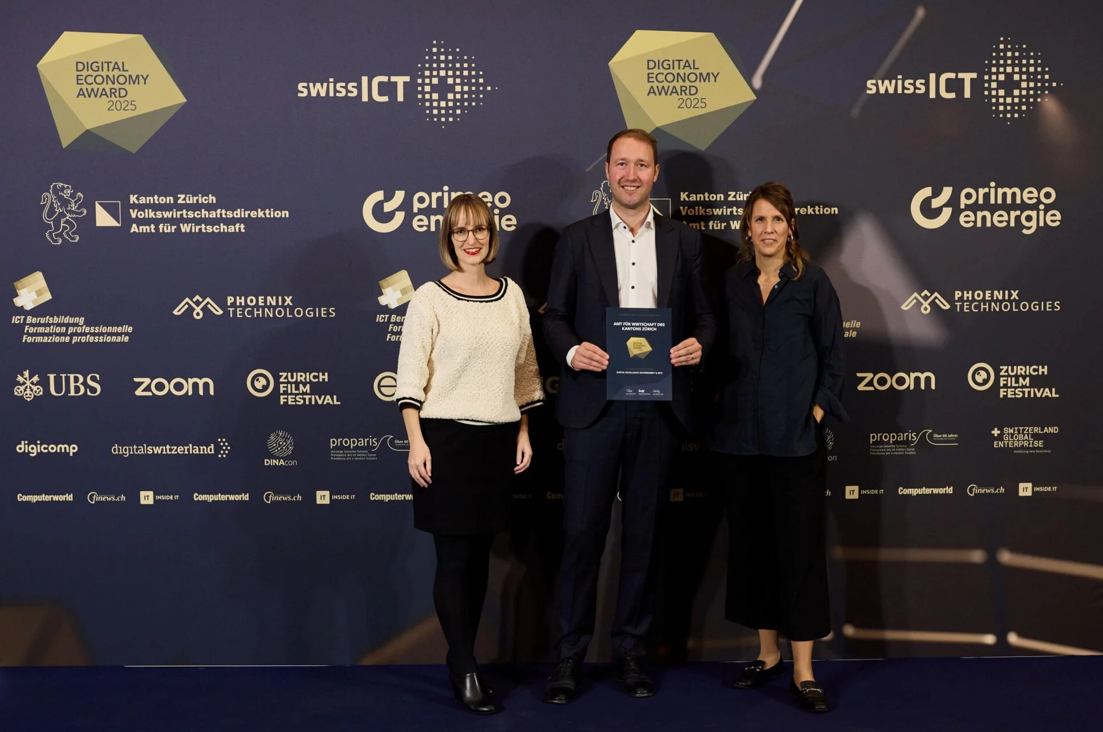
The Innovation Sandbox for Artificial Intelligence won the Digital Economy Award 2025 in the 'Digital Excellence – GOV & NPO' category. The jury praised the Innovation Sandbox as a 'beacon of digital innovation with a lasting social impact'.
About the Digital Economy Award
The Digital Economy Award is organised by the ICT trade association
swissICT. Each year, companies and organisations that are driving forward digital transformation and digitalisation in Switzerland are recognised in
various categories. In total, over 40 judges assess the ideas, projects and companies. The Digital Excellence Award NPO/GOV recognises
organisations from the public and non-profit sectors that have increased their impact or performance through digital initiatives and projects.
Location Promotion Awards 2023
The AI Innovation Sandbox has been honoured with the Location Promotion Award 2023. The jury particularly commended the clear strategic approach and highlighted the relevance of such initiatives in an international context, especially with regard to regulatory issues in the field of artificial intelligence. Furthermore, the close collaboration between a cantonal authority and companies to jointly strengthen Switzerland as a high-tech location was singled out as particularly positive.
About the Location Promotion Award
Each year, the Standort Schweiz network presents this award to recognise targeted, effective and innovative projects in the fields of location
marketing, location development and business promotion. The aim is to highlight the diversity, quality and innovative strength of projects from across the country.
Publications
ch.zh.web.internet.core.components.feedback.pleasegivefeedback
Is this page comprehensible?
Thank you for your feedback
Contact
Office for Economy – Business and Economic Development Division
Monday to Friday
8 a.m. to 12 a.m.
1.30 p.m. to 5 p.m.
